
A meeting of Tamil Nadu MPs, led by Chief Minister C Joseph Vijay, unanimously decided to oppose the Union government's proposed delimitation exercise, demanding its complete withdrawal and an extension of the delimitation freeze for another 25 years.

The Congress and BJP are engaged in a political spat over the implementation of the Women's Reservation Bill and its proposed link to delimitation, with Rahul Gandhi urging unconditional implementation of the 2023 law and Kiren Rijiju highlighting the constitutional requirement for delimitation based on post-2026 census figures.

The Indian government is reportedly developing new proposals to increase Lok Sabha seats by 50 per cent across all states. This initiative aims to address concerns from southern states regarding potential political power reduction due to population-based delimitation, while also facilitating the operationalisation of the women's quota law before the 2029 Lok Sabha elections.

The DMK has announced it will meticulously examine the proposed delimitation Bill when it is introduced in Parliament, making a decision based on its merits to safeguard Tamil Nadu's interests. The party's stance will be independent, without consultation with the Congress party, despite their former alliance.

NDA leaders have defended proposed amendments to the Women's Reservation Act and the Delimitation Bill, 2026, arguing women have waited long enough for reservation, while opposition parties allege the process could undermine India's federal and democratic structure, particularly impacting southern states.

The delimitation of constituencies, which aimed to reduce the influence of minority candidates, is a significant factor in the NDA's strong performance in the Assam elections, where they secured a record 102 seats. The 2023 delimitation exercise redrew constituencies, reserving some Muslim-majority seats for indigenous communities, which increased the BJP and its allies' seat count.

The delimitation in Assam has quietly changed the political scene, raising questions about whether new constituency boundaries helped the BJP by spreading out Muslim-majority voters.


'The Supreme Court stated that once the delimitation plan is approved by Parliament and receives assent of the President, it cannot be undone. Nor can it be modified.'

The Indian government and opposition parties are set for a showdown in Parliament over a Constitution amendment bill concerning the implementation of the women's quota law and the delimitation exercise. The Opposition is concerned about the potential impact of delimitation on the political representation of southern states.

According to a bulletin issued on Wednesday, 'The Constitution (One Hundred and Thirty-First Amendment) Bill, 2026', 'The Delimitation Bill, 2026' and 'The Union Territories Laws (Amendment Bill), 2026' will be introduced and debated for passage in the Lower House.

Amid renewed speculation about political realignments and a potential merger, senior leaders from two Nationalist Congress Party (NCP) factions met Maharashtra Chief Minister Devendra Fadnavis. NCP (SP) working president Supriya Sule clarified her party's position on the proposed Delimitation Bill, stating that while a uniform 50 per cent increase in seats across states would be hard to oppose, any final decision would be made after discussions within the INDIA bloc.
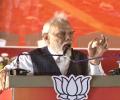
West Bengal Chief Minister Mamata Banerjee has accused the BJP-led central government of using the proposed amendment to the women's quota law as a front for the Delimitation Bill, which she claims will divide the country. She asserted that her party, the TMC, will fight this move at every step.

While the total number of assembly seats remains unchanged at 126, the redrawing of boundaries has reshaped voter composition across constituencies -- a shift that is likely to influence electoral outcomes in the years ahead.

As more opposition MPs are now aligning with the ruling NDA, sources in the government indicated that possibilities are being explored to give a fresh push to the delimitation legislation in Parliament.

Prime Minister Narendra Modi has appealed to the opposition to support the government's bills for implementing the women's reservation law, cautioning against politicisation and assuring that delimitation will be fair to all states.
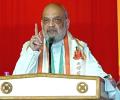
Union Home Minister Amit Shah refuted claims that southern states will have reduced representation in the Lok Sabha after the implementation of women's reservation and delimitation of constituencies, assuring an increase in both the number of seats and percentage of power.
Union Home Minister Amit Shah refuted claims that southern states will have reduced representation in the Lok Sabha after the implementation of women's reservation and delimitation of constituencies, assuring an increase in both the number of seats and percentage of power.

The Congress Working Committee (CWC) is set to meet to discuss the political situation in India, focusing on strategies to pressure the government regarding student issues, alleged embezzlement at the Ram temple, and upcoming Assembly elections. The meeting will also address the women's reservation bill.

West Bengal Chief Minister Mamata Banerjee has accused Prime Minister Narendra Modi of misleading the nation regarding the women's quota bill and plotting to push through the delimitation exercise by using women as a shield.
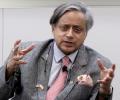
Senior Congress leader Shashi Tharoor criticised the government's decision to link women's reservation with the expansion of Parliament, calling delimitation a 'political demonetisation'. He argued that women's reservation should be implemented immediately based on existing parliamentary strength.

Parliamentary Affairs Minister Kiren Rijiju met Leader of Opposition Rahul Gandhi to discuss resolving the persistent deadlock in the Lok Sabha's monsoon session, focusing on the Delimitation Bill and FCRA Bill, though no immediate commitment was secured from the Congress leader.

The Tamil Nadu Assembly has adopted a resolution, moved by Chief Minister C Joseph Vijay, urging the Union government to permanently fix the Lok Sabha strength at 543 and implement 33 per cent women's reservation by 2029. The resolution also opposes delimitation that could disadvantage states successful in population control.

Amidst ongoing ethnic tensions, a new political alignment in Manipur sees Meitei and Naga groups uniting to demand an update to the National Register of Citizens with a 1951 base year, a move fiercely opposed by Kuki-Zo communities who fear it will disenfranchise them.

The Indian Parliament is expected to extend its budget session to introduce a bill increasing Lok Sabha seats to 816, reserving 273 for women, and amending the women's reservation law.

The Centre has notified the implementation of the Women's Reservation Act 2023, providing a 33 per cent quota for women in legislatures, Jammu and Kashmir, and Union Territories, with the provisions set to come into force on April 17, 2026.

The Women's Reservation Act 2023, mandating 33 per cent quota for women in legislatures, has been enacted, but its immediate implementation is unclear due to ongoing parliamentary debates and delimitation requirements.

A bill to implement 33 per cent reservation for women in Lok Sabha and state assemblies by increasing the lower house's strength to 850 is slated for introduction in Parliament. The bill seeks to amend Article 81 of the Constitution and utilise 2011 Census data for redrawing constituencies.

A plea has been moved in the Supreme Court by two Kashmir residents challenging the Centre's decision to constitute the delimitation commission for redrawing the assembly and Lok Sabha constituencies in Union Territory of Jammu and Kashmir.

Prime Minister Narendra Modi has appealed to opposition parties to support the delimitation-linked Women's Reservation Bill, highlighting its 40-year struggle. The bill aims to provide 33 per cent reservation for women in legislatures and increase Lok Sabha seats, requiring a two-thirds majority for passage. Despite previous setbacks and ongoing efforts to secure numbers, the government continues to push for this crucial legislation.

'The reason why they rushed through the bill was they wanted to avoid using the 2026 Census because the 2026 Census by their own decision will be a caste census.' 'The BJP knows that a significant share of the OBCs who will get captured in the census, for the first time after the 1931 Census, are against the BJP. Only a segment of the OBCs are in their favour.' 'So they wanted to avoid the OBC reservation among women, which is a demand of a lot of Opposition parties.'

Congress leader Shashi Tharoor criticised the proposal to increase the Lok Sabha's strength to 850, while BJP leaders defended delimitation as a democratic necessity at the Stanford India Conference 2026.

Sonia Gandhi criticises the government's proposed delimitation, claiming it's a politically motivated move to delay the caste census and gain an unfair advantage, rather than genuinely promoting women's reservation.

The ruling BJP has increased its lead over the Congress in the Rajasthan urban local body elections, winning 3,587 wards against Congress's 3,050. Independents also performed strongly, securing 2,024 wards. While BJP secured a clear majority in Udaipur, Congress won in Ajmer and Pali. Bharatpur, the Chief Minister's hometown, saw Independents leading. These elections are a crucial test for the Bhajanlal Sharma-led BJP government ahead of the 2028 Assembly polls.

Prime Minister Narendra Modi and West Bengal Chief Minister Mamata Banerjee engaged in a war of words during election rallies, with Modi accusing the TMC of supporting divisive forces and Banerjee alleging the BJP plans to divide the state.

Lok Sabha Speaker Om Birla announced that voting on three crucial bills, including amendments to the women's quota law and the establishment of a delimitation commission, will take place at 4 PM on Friday, following an anticipated 15-18 hour debate.

The BJP and opposition parties are engaged in a political battle over the implementation of the Women's Reservation Act, with the BJP defending it as historic and the opposition accusing the government of delaying its notification and using it to push an unconstitutional delimitation exercise.
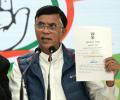
Assam Chief Minister Himanta Biswa Sarma has accused Congress leader Pawan Khera of attempting to contact militant groups to influence election results, stating that several FIRs have been registered against him and an investigation is underway.
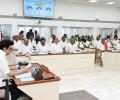
Moving a resolution, Stalin said that in the event of increase in the number of seats in Parliament, 1971 Census should be the basis for it. Also, the 1971 Census should be basis for delimitation of LS seats for 30 years from 2026, he asserted.

The Lok Sabha is set to expand to 815 seats, with 272 seats reserved for women, according to Union Law Minister Arjun Ram Meghwal. The move aims to implement the women's quota without disadvantaging men or any state. The proposed legislations also include provisions for reservation for women from SC and ST categories within the women's quota.
